The difference between a customer letting an agent spend $50 and letting it spend $5,000 does not come down to agent capability or user experience. This decision will be based on the user's confidence that the downside risk is bounded.
Users will delegate low-stakes actions when the cost of a mistake feels tolerable. They hesitate when the agent is handling SaaS renewals, contractor payments, travel, vendor invoices, or other workflows where the wrong purchase creates real operational pain.
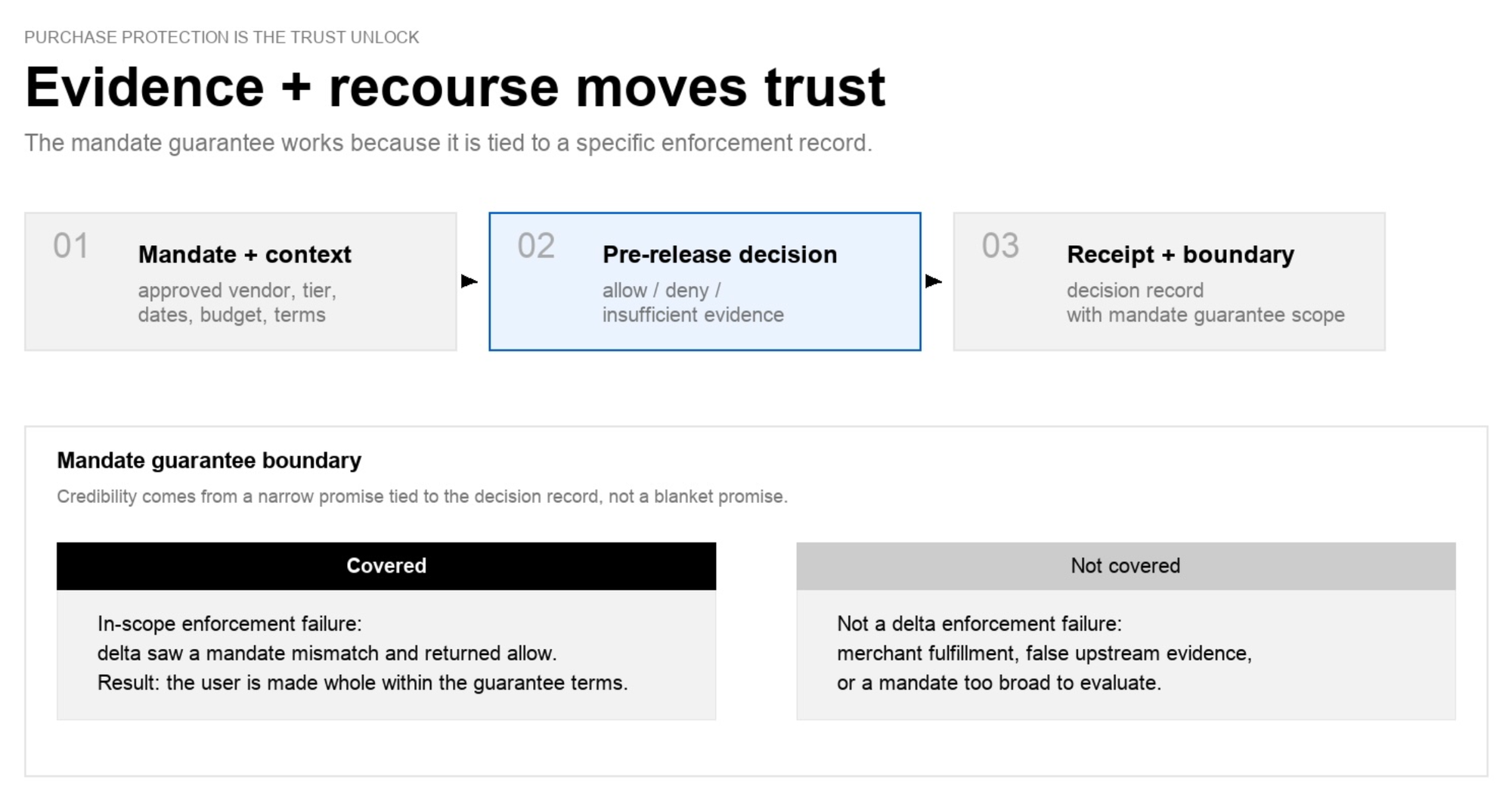
The trust threshold moves when the platform can show two things: the agent's proposed action was checked against the user's mandate before funds moved, and the user has bounded recourse if the enforcement layer fails.
That is what delta provides: policy enforcement before payment release, a mandate execution receipt showing what was checked, and a mandate guarantee that makes the enforcement boundary commercially usable.
Convenience Does Not Create Trust At Higher Spend Levels
Agentic commerce is often framed as a convenience story. The agent compares options, fills forms, completes checkout, and saves the user time.
That works for low-value purchases. It breaks down when the user has to inspect every confirmation email, invoice, and receipt afterward to make sure the agent did what they meant.
At that point, delegation has not removed work. It has moved the work into after-the-fact verification.
The real product question is not "can the agent complete the purchase?" It is "under what conditions will the user trust the agent to complete the purchase without rechecking everything?"
The Missing Mechanism: Policy Enforcement Before Payment
delta evaluates the agent's proposed action before funds move.
The platform passes delta the mandate and the proposed purchase context: merchant, amount, SKU, tier, payee, dates, contract terms, budget constraints, or other policy fields. delta returns one of three useful states:
- allow: the proposed action satisfies the mandate.
- deny: the proposed action violates the mandate.
- insufficient evidence: delta cannot confirm compliance from the available evidence.
That last state matters. If the evidence is insufficient, payment should not silently proceed. The platform can route the gap to the user, a support workflow, or an exception queue.
The user does not need to watch every checkout. The enforcement step does the checking before money moves.
The Receipt Is The Audit
Every decision produces a mandate execution receipt.
The receipt records:
- what the user authorized;
- what the agent proposed;
- what evidence delta checked;
- whether delta returned allow, deny, or insufficient evidence;
- which policy and engine version were active;
- what guarantee boundary applied.
This is the record that support, risk, finance, procurement, legal, and engineering can all use later. It is not a reconstructed log. It is the signed record of the enforcement step at decision time.
That is the difference between asking a user to trust an agent and giving the user proof that the agent was constrained.
The mandate guarantee makes the trust boundary clear
The mandate guarantee is not a blanket promise that every bad outcome is covered. It is a bounded commitment around delta's own enforcement decision.
A covered example: the user authorized renewal at the standard tier. The agent proposed the premium tier. The evidence available to delta showed the tier mismatch. delta returned allow anyway. That is an in-scope enforcement failure, and the mandate guarantee makes the user whole.
A non-covered example: the agent submitted incorrect evidence, the merchant failed to deliver, or the policy was too broad to determine whether the purchase was compliant. Those are not delta enforcement failures. The receipt records what delta saw and what boundary applied.
The narrowness is what makes the guarantee credible. It is specific enough for platforms to explain, support teams to adjudicate, and users to understand.
What This Unlocks For Platforms
When the downside is opaque, users keep delegation limits low. When the downside is visible and bounded, users can delegate more meaningful workflows.
For a spend-management platform, that might mean trusted SaaS renewals, vendor payments, or travel booking. For an AI commerce platform, it might mean a protected purchase mode that does not add approval clutter unless evidence is missing. For an issuer or wallet, it might mean a stronger trust layer around agent-initiated transactions.
The first pilot does not need to cover every purchase. It can start with one workflow, one policy class, and one success metric: higher delegated limits, fewer manual reviews, cleaner disputes, or faster exception resolution.
The point is not that the agent becomes perfect. The point is that the platform can show the agent was constrained, the decision was recorded, and covered enforcement failures have a defined recourse path.
Agentic spend grows when users know the agent is not just permitted to pay. It grows when users know the agent is constrained by the mandate, and the platform can prove it.